
An air-freight enquiry needs both the packed weight and the packed dimensions. A light, bulky shipment can take more aircraft space than a smaller, heavier one. This guide explains air freight chargeable weight with a simple example so you can prepare the information WCL needs.
Gross and dimensional weight
Gross weight is what the packed cargo weighs on the scale, including cartons, pallets and packaging. Volumetric or dimensional weight is a size-based estimate. It uses the packed outer dimensions and a divisor specified for the service.
DHL Global Forwarding’s explainer illustrates air cargo with a 6000 divisor and notes that carrier rules can differ. DHL Express India’s guide uses 5000 for its express example. Confirm the factor and measurement rules for your service. IATA’s general overview, dated July 2021, also explains weight-based pricing and possible extra charges; it is not a current freight tariff.
Air freight chargeable weight: a worked example
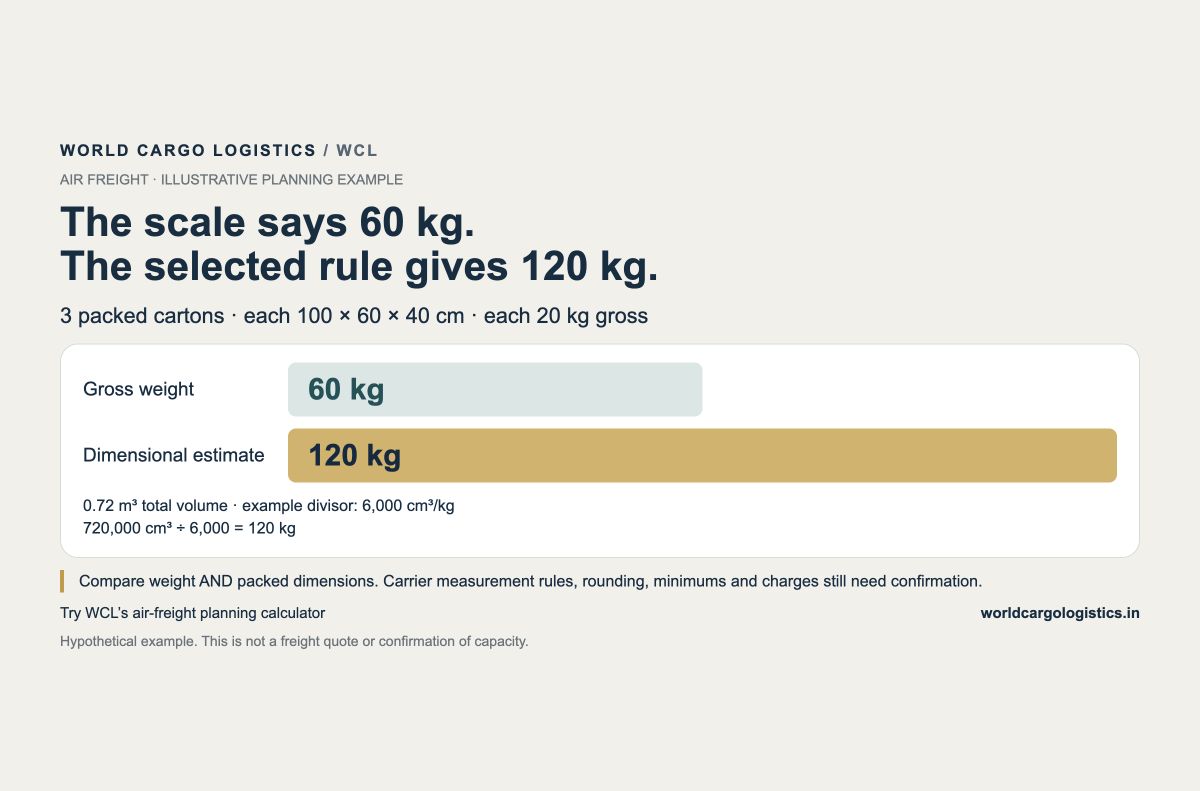
Consider an illustrative, hypothetical shipment of 3 identical packed cartons, each measuring 100 cm × 60 cm × 40 cm and weighing 20 kg gross:
- Total actual gross weight: 3 × 20 kg = 60 kg
- Packed volume per carton: 100 cm × 60 cm × 40 cm = 240,000 cm³ (0.24 m³)
- Total packed volume: 3 × 240,000 cm³ = 720,000 cm³ (0.72 m³)
- Hypothetical dimensional estimate at a chosen 6000 divisor: 720,000 ÷ 6000 = 120 kg
- Preliminary comparison (6000 assumption): Comparing 60 kg gross mass with the 120 kg dimensional estimate gives 120 kg before carrier rounding, minimums, or measurement rules.
- Alternative hypothetical 5000 divisor assumption: 720,000 ÷ 5000 = 144 kg (a different service assumption, not a live quote or universal rule).
These hypothetical figures do not establish a freight rate, capacity commitment, or carrier acceptance. Never remove protective packaging to reduce dimensions.
Prepare a complete WCL enquiry
Test preliminary figures on the WCL Air Freight Calculator, which supports selectable 6000, 5000, and 4000 assumptions across per-piece dimensions and weights as a planning estimate.
When submitting a WCL Air Freight Quote Enquiry, share:
- Packed outer length, width, and height with units per package type
- Piece count and gross mass per piece and total (with packaging/pallets)
- Origin, destination, and cargo description
- Ready date, stackability, and declared special handling
Ask the WCL desk to confirm the applicable service, divisor/measurement basis, quote validity, inclusions, and exclusions.
Sources
- DHL Global Forwarding: calculating chargeable weight
- DHL Express India: large-item shipping and its express example
- IATA: general air-cargo tariffs and rules overview, 27 July 2021
Sources checked on 2026-11-12. This is a planning guide, not a live freight tariff.